This is probably one of the best animated shorts I've seen in awhile to explain why modern consumerism is not sustainable. A very light-hearted approach to understanding why buying locally and making good decisions when buying products is needed. I've posted the first part here, but it's a 7 part series, and the author has dozens more similar videos.
They are supported by the Tides foundation and the Funders Workgroup for Sustainable Production & Consumption.
Note from Plisko:
I liked this so much that I went and made a playlist so that the whole series should now play as one video. Each segment is only about 2+ minutes, so it's around 15-20 minutes total runtime.
Monday, February 4, 2008
The Story Of Stuff


Sunday, February 3, 2008
Sunday Inspiration - Ted Talks: Bill Strickland
This video is from a site known as Ted Talks TED Stands for Technology, Entertainment, and Design and it is an organization dedicated to bringing together the great thinkers and doers in the world who are challenged to give the best public talk of their lives, in 18 minutes or so. They make videos of these speaking engagements available to the public for free under a collective commons license.
Bill Strickland is a man who had a vision to build a training center for poor and underprivileged people in a rough neighborhood in Pittsburgh. His approach is different from many such attempts however. He believes that the tone you set about how much you value people in these schools is something that needs to be established right away before you start giving them speeches. As a result he has insisted that his center have things like fountains, flowers, fine art, hand crafted furniture and gourmet meals in the cafeteria at tables that look more like a high profile business dinner. He believes that these things have a psychological impact on the students that breeds much more success in the program. The video above is a very famous slide show that he has taken around the country to raise money and awareness about his dream. He is accompanied by Herbie Hancock on piano as he speaks. It is an incredibly moving and inspirational story he tells about his accomplishments and goals. Everyone who has ever been involved in education really needs to see this.
Sunday Inspiration - Black Eyed Peas: Yes We Can
I find it very interesting that something like this video below, which is essentially a song that backs a political candidate, can strike a note inside of you that makes you think.
A political mashup meets a collage of music sung by some hollywood and music industry heavyweights (Black Eyed Peas, Kareem Abdul Jabbar, Scarlet Johannsen, etc.) turns into subtle political art. So simple, but so poignant. This particular video is a wonderful minimalist approach to creating art as a political tool.
Also hosted at dipdive.com
SUNDAY FEATURE: The Possibility Of Hope
Hey, it's Zen's first Sunday Feature.
Gary Tarn (Black Sun) returns to moviemaking in 2007 as the 16mm Cinematographer of the 27 minute documentary directed by Alfonso Cuarón: The Possibility Of Hope.
This documentary takes a look at different matters of the world such as immigration, global warming and capitalism through the eyes of scientists and philosophers.
YouTube Playlist parts 1-3:
Saturday, February 2, 2008
Gary Tarn: What's Wrong With Modern Cinema?
This is part 2 of a 5 part Interview I did with Cinematographer & Composer Gary Tarn & Hughes de Montalembert on Tarn's independent documentary BLACK SUN about Hughes life. Click here to see other clips from this interview.
In 1978, Hughes de Montalembert, a French filmmaker and painter living in New York City, was attacked by two men on the way back to his apartment. During the struggle, paint thinner was thrown into his eyes by one of his assailants, scarring and blinding him for the rest of his life. For many, the story would have ended right there. For Hughes, it was just the beginning.
Eighteen months after being blinded, Hughes began to travel the world -- alone.
Thursday, January 31, 2008
How To: Metacafe - Unbelievable! Paper Toy Transformer, By Golics
Metacafe will pay producers for their videos if they generate a lot of hits at the site. The videos that always seem to do well are the crafty and "how to" videos that show you how to to tricks and make gadgets. They are very easy to produce when you consider how well they can pay. This particular one, made by producer Golics, shows you how to make a paper toy. It has made $1300 so far with 277,27 views since October 2007. Golics has made $6,600 off all his videos there so far. All of them show different kinds of tricks with paper.
Wednesday, January 30, 2008
Examining the FISA Bill
The Real News Network presents this analysis by Republican constitutional lawyer, Bruce Fein of the proposed modifications to the FISA bill (AKA "The Protect America Act") and the resulting controversy, as it has been going through congress. Anybody that has been following Glenn Greenwald's excellent coverage of this issue knows how corrupt the situation has become. Bruce Fein does an excellent job of explaining this and also pointing out the failures, if not outright compliance, by people like speaker of the house Nancy Pelosi to stop the administration's lawless posture.
The "short" version:
The Bush Administration asked companies like AT&T and Verizon to open up their access to American electronic communications of all kinds, with people outside the country, without warrants. Millions of calls and emails and internet hits were tapped by the government over a 2 or 3 year period with no oversight. If you spoke with or emailed someone outside America, it might have been you.
Some companies, such as Quest, refused because their team of lawyers told them it was grossly illegal. This cost them millions in government contracts. This wiretapping without warrants is a violation of our right to privacy and the companies are now being sued for breaking the law, which is very clear about what is required in these situations. Meanwhile, the law of the land which has protected us from both terrorists AND government abuses is up for "modification" in congress. Dick Cheney has pulled some allies together in congress to get a provision put into that new law that these telecommunication companies should be immune from any legal action as a result of their wiretapping on behalf of the government.
This immunity would serve two purposes: It protects AT&T and others from millions, maybe billions, worth of lawsuits by citizens who'se rights were violated. It also prevents any investigation at all into exactly what was going on during all that wiretapping and who actually got tapped. If the government was good and appropriate with it's power, we will never know. If the government grossly abused it's power, we will never know. The whole thing would be completely sealed.
The administration and it's allies claim is that these lawsuits would expose national security secrets to our enemies in the public record and that it would discourage companies from cooperating with the government in the future, which would, in turn, help the terrorists win. Both of these claims are false. The existing law that has been on the books all these years allowed trials with sensitive evidence to be tried in special courts that were designed specifically to protect that evidence. Companies like AT&T are also not in a position to refuse a legal request by the government for wiretaps with a warrant. THAT would be break the law. These warrants could also be obtained within 72 hours AFTER the tap took place, so there is no concern about expediency which is another administration claim. We have always been able to spy on terrorists overseas talking to people in America. The modifications needed because of technology were very minor and, like a corrupt auto mechanic, the administration made a bunch of bogus claims and jacked up the price, in liberty, that we must now all pay.
This is called "Trust Me Government." The exact kind of thing that every Republican I know has been against for as long as I have known them. Yet there they are, the people who came into power promising that scariest thing they could ever here was "I'm from the government and I'm here to help" telling us to trust the government, it's here to help. This time, though, it isn't a social worker or a welfare check. It is guys with headphones, laptops and digital recorders sitting in an AT&T hub in San Fransisco.
Sunday, January 27, 2008
Thursday, January 24, 2008
Music: Preston Reed - Life
I found Preston Reed while browsing around at the Broadjam Website. It's pretty cool solo guitar riffing. Broadjam is also a cool independent music site where you can upload your songs and get reviewed by the community. They also do videos and let you sell your songs as downloads for 99 cents. One of the downsides is that you can only acess the content on the broadjam website. There doesn't seem to be any way to embed their content into blogs so I can share a direct link to the material. I had to find the YouTube version to share it here. Looks like YouTube gets the clicks this time until Broadjam can work it out.
Sunday, January 20, 2008
People at Current TV
[UPDATED BELOW and the body has been edited for more clarity]
"Well, as you know, viewer-contributed content is essential to our mission, which is about democratizing television. We're about telling stories that aren't being told right now. We're about giving the audience a complete voice and a complete role in what we're doing. Our mission statement begins with working with the audience, to create a new category of content.
So I don't think you're ever going to see us increasing the amount of professionally produced content we offer. But I think what you are going to see is that the quality level of viewer contributions is going to get better and better."
-David Neuman, President of programming, Current TV
As some of you may know all of us here at Media Crashers are citizen video producers who have been past supporters and contributors to Current TV , Al Gore's cable network. Over the past few months, many of us have been very troubled by the changes at Current which seem to be taking away the essential genius that the network represented: putting citizens in control of what they see on TV.
Originally, members of the Current website had two options: those who had production skills could submit "citizen journalism" videos for consideration as TV content and those who didn't could still participate, in a very real way, by becoming "citizen programmers." Any member could contribute their vote to "greenlight" submissions and this would push the videos they liked up the ranks. The heart of this voting system was was called "the leaderboard" which was like a top 1000 list of the videos as ranked by the voters. There was a unique, dramatic, thrill to watching your video, or a video you voted for enter at about 200 or 300 and slowly rise and fall through the ranks, depending on how well it did. To win the number one spot was the ultimate rush and the greatest validation a producer could receive. The process was also very open. Just like a democracy where citizens can watch the votes being counted, the web interface displayed the greenlight voters, the scores, and the value of each person's vote so that it was possible to go back and do the math if someone wanted to.
Unfortunately, this whole system of bringing the people directly into the programming choices was done away with as the final stage of what appears like a slow takeover by the Current staff. Ironically, this was right about the time Al Gore won an emmy for "interactive television"
The "redesigned" website has no leaderboard and it looks more like a social networking meets DIGG/Delicious page where staff and members blog their thoughts. People can still upload videos but they are all buried in the mechanics of things like collecting each other's profiles, sharing links with each other, answering staff questions with webcam videos, following staff "assignment desk" projects rather than making up their own, and collecting links to viral videos they like. These things in themselves are not necessarily bad additions to the website. The problem is that all of this stuff goes into a giant blob of "content" which also includes in house staff videos mixed in, with no separation or distinction. The "leaders" in the community seem to me much more staff centered than member centered. As a citizen producer, you can't even find a list of your own videos in your profile.
So how has this all worked out?
Someone just sent me some interesting research they did about Current TV.
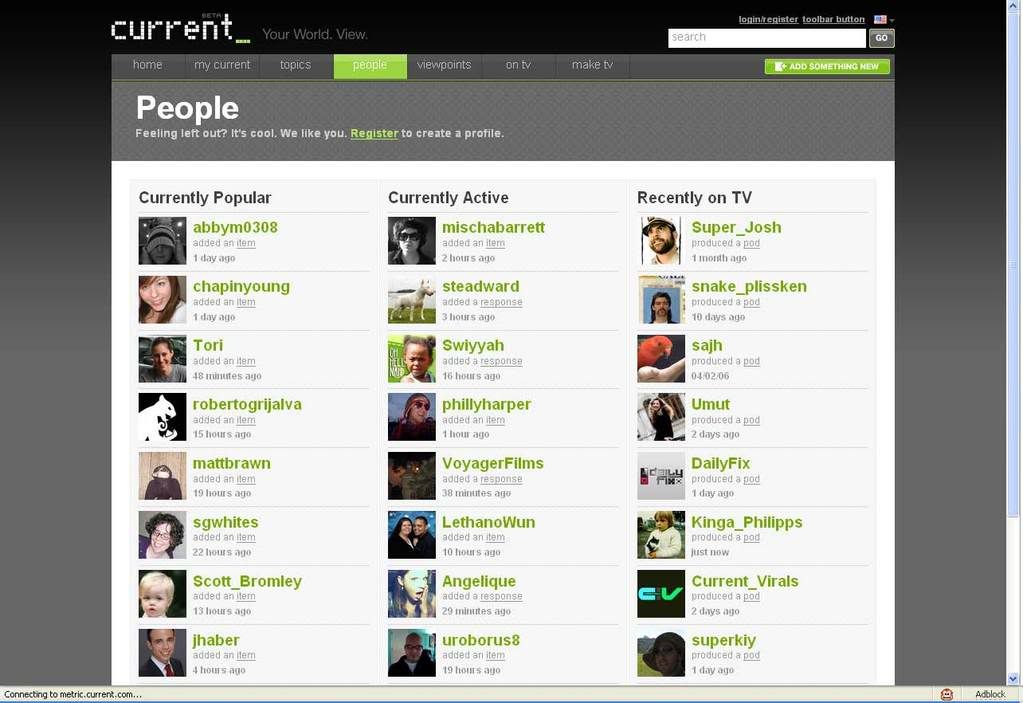
Here is a screenshot they took of the "People" page at Current.com. It is the front page of this section where the most popular and most active people can be found.
Here it is:
Click on it for a larger image:
This next picture shows the exact same screen shot but the researcher went through the profiles of each person and anyone who is on the Current Staff has been marked:
Click for Larger Image:
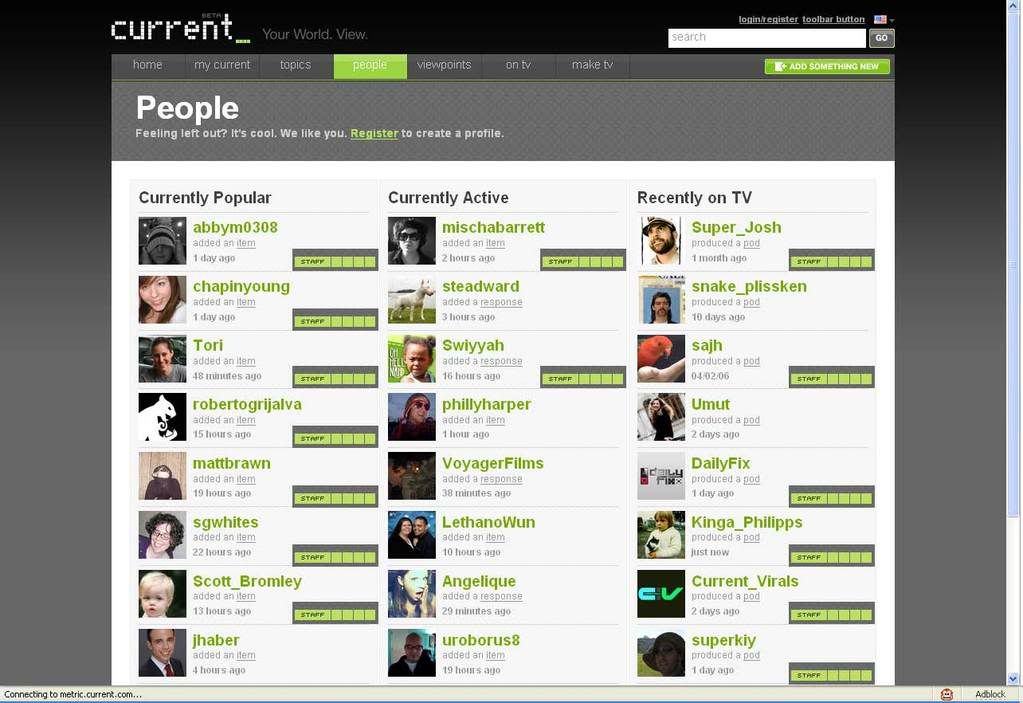
I'll let the images speak for themselves.
UPDATE:
Apparently some in the comments believe that it is the ability to pitch stuff to Current that makes it democratic. I would submit that every network in the world accepts pitches from people, even ordinary people which is what all feelance TV producers start out as. Listening to anybody who wants to talk is not what makes something democratic. It is the process people can use to put their voices forward that defines "democratizing the media." I don't believe that a cable network staff is an underrepresented minority when it comes to deciding TV content. I also don't believe an "assignment desk" where staff tell the people what kinds of productions they want submitted is a brave new approach to making television. Democritizing the media means that people can start the conversation, submit their ideas and then look at everyone's ideas and vote, in an open and verifiable way, for the ones that should go on TV. The Current staff have always made their own content along side and they have also made their own choices from the submissions. I don't have a problem with that. The difference today is that the audience is no longer bypassing staff and choosing content independently as a way of balancing out staff picks (or vise versa). That is the heart of the problem for me. The voting today has no transparency and it is a "recommendation" not a final decision.
UPDATE II:
I my recent contacts with Current I have been informed that they understand the problems with their website and have changes coming including a "bigger and better" leaderboard. I'm not sure what this means. It was the "improvements" they made to the old leaderboard that led to it's dysfunction and eventual termination in the first place. Despite my lack of confidence, I will remain hopeful. The community that they inspired is still there trying to make a difference.
Subscribe to:
Posts (Atom)